 Softbooq
Inventory & Stock
Softbooq GoWhat you hold, where it sits, and what it is actually worth.
Stock down to the bin, valued by a cost-flow method your accounting framework permits, moving automatically as you sell, build and receive. Every movement posts to the ledger split by what kind of stock it is, so the balance sheet and the shelf tell the same story.
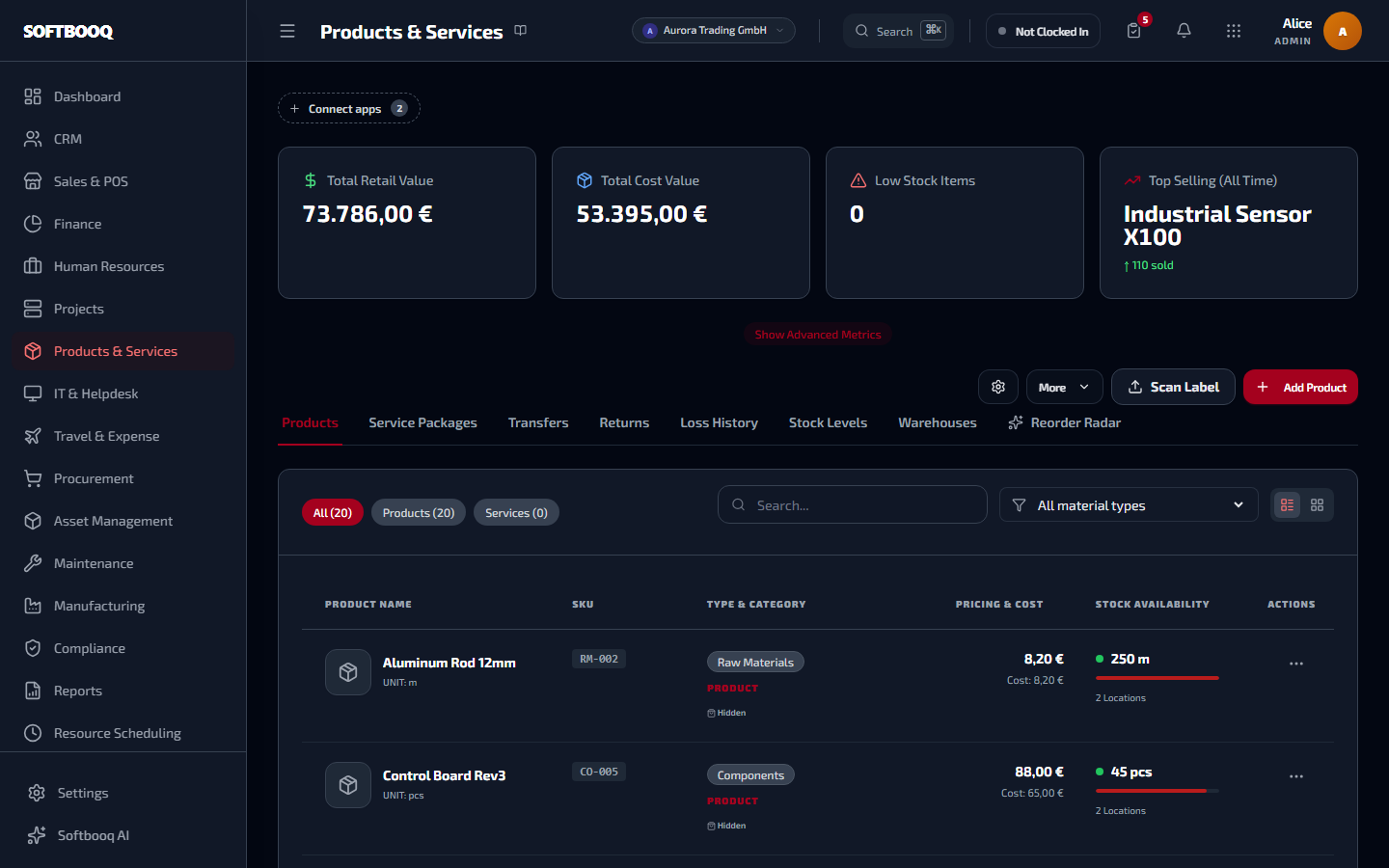
An unretouched screenshot from a live workspace.
01
Knowing what you hold
A single quantity per product is enough right up until the moment you have two locations, and then it is worse than nothing.
Stock per location, down to the bin
Warehouses with bins inside them, each holding its own quantity, so picking is directed rather than remembered. One number per product across a business with three sites is a number nobody can act on.
Live levels across every site
What is on hand, what is committed, and what that leaves available, per location and in total. The figure a salesperson needs is the third one, and it is the one most systems make you calculate.
Transfers that exist while they are in transit
Stock moving between sites is in transit, not missing from one and not yet in the other. That gap is where inventory goes unaccounted for and where a stock count stops reconciling.
Scan instead of type
Receive, transfer, pick and count by barcode on the phone already in the picker's hand, so the record is made where the work happens rather than re-keyed afterwards from a clipboard.
Products and service packages together
Physical goods and the bundles or services you sell alongside them live in one catalogue, so a quote can carry both without a second system.
02
What it is worth, under the rules that bind you
Valuation is the part of inventory that reaches the accounts, and the part where the permitted answer depends on which framework you report under.
Cost-flow methods gated by your framework
FIFO, LIFO, weighted average and standard cost. LIFO is prohibited under IFRS and permitted under US GAAP and German HGB, so the framework you report under decides which methods you may even select. The choice changes cost of goods sold and closing stock value on identical transactions.
Real cost layers, not an average of an average
Receipts are held as tranches at the cost they arrived at. FIFO consumes the oldest, LIFO the newest, weighted average collapses them. The cost of goods sold on a movement comes from the layers it actually consumed.
Inventory split by material type in the ledger
Raw materials, work in progress, finished goods and merchandise post to their own asset accounts. Goods receipt, production, cost of sales and shipment all route through the same splitter, so what an item was booked into is what a later posting takes it out of.
Help getting cost price right in the first place
Landed cost is more than the invoice line. The cost assist exists because a cost price entered as the supplier price alone quietly overstates every margin you report afterwards.
03
Stock that moves itself
Every adjustment here is a posting somewhere. The point is that you do not have to remember that.
Shrinkage posts as shrinkage
Loss, damage and correction each write a real journal entry against the shrinkage expense account and credit inventory, with the reverse for a gain. Stock that vanishes should cost you in the accounts, not just in the count.
A loss register, not a silent write-off
Every write-off recorded with its reason and its value, so the pattern is visible. Shrinkage you cannot see by category is shrinkage you cannot do anything about.
Returns back to the supplier
Faulty or over-delivered stock goes back against the original receipt, with the credit expected from the supplier tracked rather than assumed.
Counts that reconcile to the ledger
A physical count produces a variance you can see and post, so the difference between the shelf and the books is closed deliberately rather than absorbed.
04
Reordering before you run out
Most stockouts are predictable from the sales you have already made. This does that arithmetic nightly so nobody has to do it weekly.
Days until stockout, per SKU
Sales velocity and a seasonal factor produce a forecast of when each line runs out, ranked critical, warning, healthy, overstock or no-velocity. It is statistics on your own sales history, not a guess and not a black box.
A recommended quantity and supplier
Each flagged line carries a suggested order quantity and the supplier to buy it from, so acting on it is one step rather than a research task.
Recalculated overnight, or on demand
The forecast refreshes on a schedule server-side so the list is current when you open it, and you can force a recalculation after a big day rather than waiting for tonight.
The details that took the longest
Small decisions you only make after getting them wrong.
Every one of these is a specific behaviour, chosen for a specific reason. They are the difference between software that demos well and software that survives a year of month-ends.
Your accounting framework decides which costing methods you may choose
LIFO is prohibited under IFRS, permitted under US GAAP and German HGB. Rather than offering every method to everyone and leaving the tenant to know the rule, the framework gates the list. Choosing a method your standard forbids is not a preference, it is a misstatement.
What stock was booked into is what a later posting takes it out of
Goods receipt, production, cost of sales and shipment all compute the material-type split through one function. If receipt and issue disagreed about which asset account a finished good belongs to, inventory would drift between accounts while the total still looked right.
Unclassified stock behaves exactly as it did before the split existed
A set made entirely of unclassified items collapses to a single line against the legacy inventory account, for the exact total. Adding material-type accounting to a live business must not silently restate the stock it already holds.
Nothing is an island
What reaches Products & Services without anyone typing it again.
Every one of these is a real data path, not a promise of "full integration".
Before you ask
Questions people ask about Products & Services.
- Can I track stock across multiple warehouses?
- Yes, per location and per bin within a location, with movements between them recorded rather than adjusted.
- Which inventory costing methods are supported?
- FIFO, LIFO, weighted average and standard cost. Which of them you can select depends on your accounting framework, because LIFO is prohibited under IFRS while US GAAP and German HGB allow it.
- Does stock value reach the accounts automatically?
- Yes. Receipts, production, sales and write-offs all post to inventory asset accounts split by material type, so the balance sheet follows the shelf.
- Does Softbooq tell me when to reorder?
- Yes. A nightly forecast uses your sales velocity and a seasonal factor to estimate days until stockout, ranks each line by urgency, and suggests a quantity and supplier.
- Is the reorder forecast AI?
- No. It is arithmetic on your own sales history - velocity and seasonality - which is why the numbers behind it are inspectable rather than a black box.
- What happens to stock that goes missing?
- It is recorded as a loss with a reason and posts to a shrinkage expense account, so it shows up as a cost rather than quietly reducing the count.
Where to look next.
All 18 modulesSee Products & Services with your own numbers in it.
Start a free 30-day trial. No card required. Try every module on Softbooq Pro from day one.