 Softbooq
Sales & Point of Sale
Softbooq GoOne price, one stock figure, one ledger - counter, phone and web.
A register that keeps trading when the internet does not. A quote that becomes an order, a delivery and an invoice without retyping. And the rules that differ by country - fiscal devices, cooling-off periods, EU sales reporting - handled where they apply and silent where they do not.
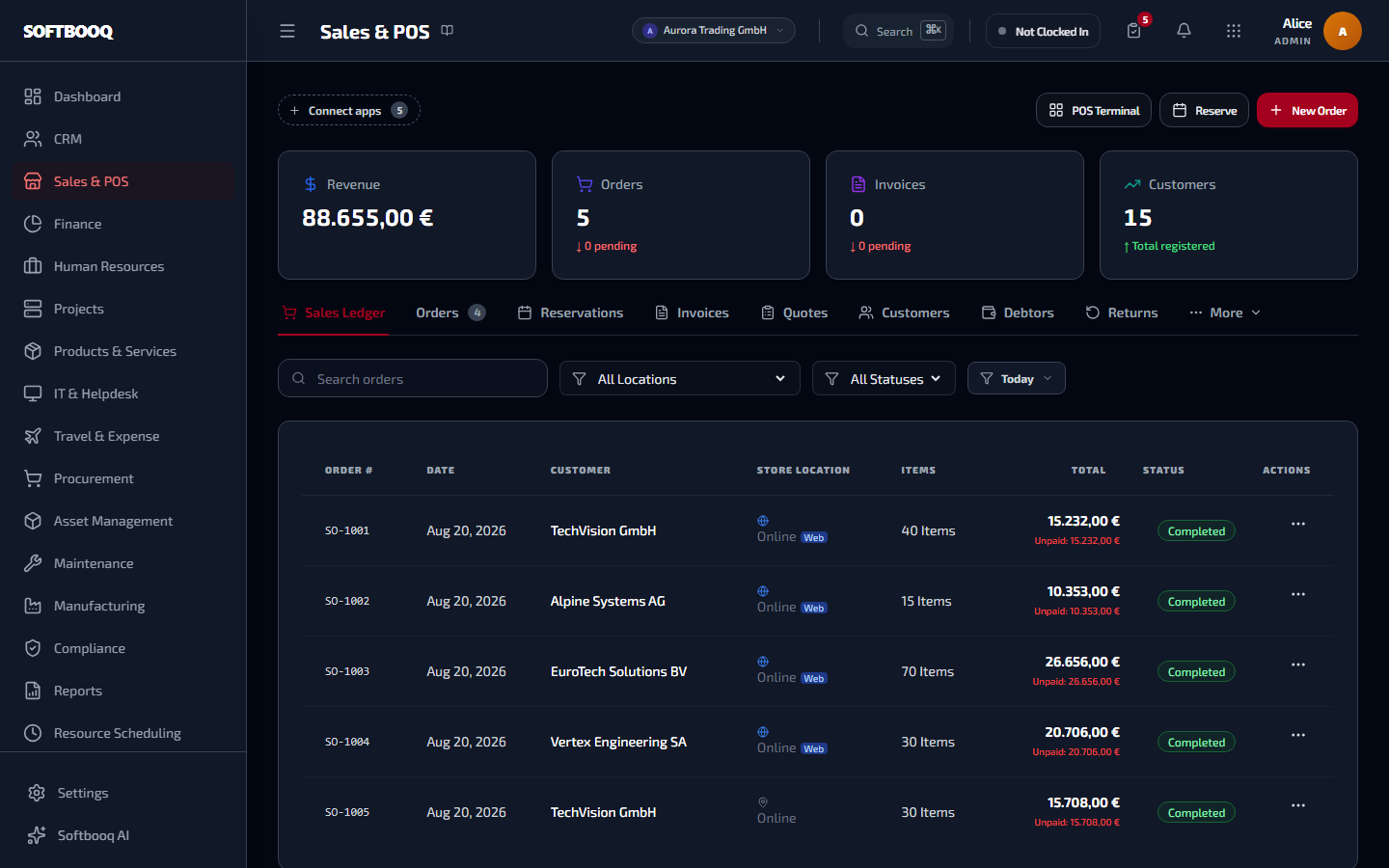
An unretouched screenshot from a live workspace.
01
The counter
A shop cannot stop trading because a connection dropped, and a cash drawer that only balances in theory is not a cash drawer.
A register that works offline
Sales keep going through an outage and sync when the line returns. The register is the part of the business that cannot wait for infrastructure.
Cash sessions that reconcile
Open a session with a float, record pay-ins and pay-outs, and close against an expected figure the system computes rather than one somebody estimates. A variance is a number, not an argument.
Multiple registers, each with its own drawer
Several registers in a shop, or several shops, each with its own session and its own reconciliation, rolling up to one set of books.
Credit checked before the sale completes
A pay-later customer is checked against their limit at the register, with an override that is recorded against whoever approved it rather than waved through.
Receipts by the channel the customer wants
Print it, email it, or send a link. A shopper who does not want paper should not be issued paper.
02
Quote, order, deliver, invoice - once
The chain most businesses run through three tools and a spreadsheet, with the reference carried the whole way so any document finds the others.
Quotes that archive themselves
A quote PDF is stored on first access and registered in the same file library as invoices, purchase orders and payslips - searchable, AI-indexed and governed by the recycle bin, rather than living in the sender sent-items.
Accepted quote becomes the order
Convert on acceptance with nothing retyped, and the quote reference follows through onto the invoice so the customer sees the number they agreed to.
Orders through to fulfilment
Placed, picked, delivered, invoiced - with what is outstanding visible at each point instead of inferred from whether anyone has complained.
Reserve now, collect later
Hold stock against a named customer with the reservation visible at the counter, so the item is not sold twice and is not written off as shrinkage when it disappears from the shelf.
Returns against the original sale
A return is processed against the transaction it came from, restocked where appropriate, and reflected in the ledger - not handled as a negative sale that quietly distorts the numbers.
Who owes you, at a glance
A debtors view built from the same ledger as everything else, including customers running behind on an installment plan.
03
One price, wherever the sale happens
The commonest way a multi-channel business loses money is charging different amounts in different places and finding out from a customer.
The price rule exists exactly once
Edge functions, the ERP, the storefront and the register all call the same resolver, so they cannot disagree about what a customer pays. That expression was previously copied into six places, which is precisely why it now lives in one.
Promotional pricing with a start and an end
A markdown carries its own dates, so a sale begins and finishes on its own rather than because someone remembered to change it back on Monday.
Channel-aware pricing
Different prices by channel where you want them, resolved through the same rule - so a deliberate difference stays deliberate and an accidental one cannot happen.
04
The rules that change at a border
Retail law is not universal. This is handled per market, applied where it binds and absent where it does not.
Fiscal device requirements, honestly handled
Where a country requires a certified register, the register is closed - because Softbooq is not a certified fiscal device anywhere. The only way through is your own audited attestation naming the certified device you already run.
Cooling-off notices only where they are owed
The storefront states a withdrawal right derived from your country, and says nothing outside the EU, EEA and UK. Overridable both ways: offer a returns window anywhere as a selling point, or switch it off if you sell only to businesses.
EC Sales List prepared from the ledger
Zero-rated supplies to VAT-registered customers in other member states, with their VAT number, country and period total, as the recapitulative statement the directive requires and the authority matches against their return.
The details that took the longest
Small decisions you only make after getting them wrong.
Every one of these is a specific behaviour, chosen for a specific reason. They are the difference between software that demos well and software that survives a year of month-ends.
The register refuses to run rather than pretend to be certified
Where a market requires a certified fiscal device, Softbooq closes the register instead of quietly operating as one. The escape hatch is the merchant attesting, on their own audited record, that they already run a certified device and naming it. Software that implies a certification it does not hold puts the fine on the merchant.
The register and the server read the same country list
The point of sale imports the fiscalization rule from the same shared module the edge function enforces with. Duplicating that list is the one outcome that would genuinely be dangerous - blocked in one place and allowed in the other, with nothing to reveal the disagreement until an inspection.
Silence outside the EU is a decision, not an omission
Most of the world has no statutory cooling-off period for online retail. A checkout that volunteers "cancel within 14 days" would bind a merchant in Lomé or Lagos to a promise their law never made and their margins may not survive. So it says nothing there, and you can still choose to offer it.
Nothing is an island
What reaches Sales without anyone typing it again.
Every one of these is a real data path, not a promise of "full integration".
Before you ask
Questions people ask about Sales.
- Does the POS work without internet?
- Yes. The register keeps taking sales offline and synchronises once the connection returns.
- Can I sell online and in-store from the same stock?
- Yes. The storefront and connected channels share one stock pool with the counter, so a sale in either place reduces the other.
- How do you make sure online and in-store prices match?
- There is a single price resolver that the storefront, the register, the ERP and the edge functions all call. There is no second implementation to drift.
- Can you be used as a fiscal register in Germany or France?
- No, and the software will not pretend otherwise. Where a certified device is required the register is closed unless you attest, on your own audited record, that you already operate a certified device.
- Does the storefront handle EU cancellation rights?
- Yes, where they apply. The withdrawal notice is derived from your country, stays silent outside the EU, EEA and UK, and can be overridden in either direction.
- Can customers buy now and pay later?
- Yes. Credit limits are enforced at the register, and any override is recorded against the person who approved it.
Where to look next.
All 18 modulesSee Sales with your own numbers in it.
Start a free 30-day trial. No card required. Try every module on Softbooq Pro from day one.