 Softbooq
Reporting & Analysis
Softbooq PlusStatements in your reporting standard, that you can click into.
Profit and loss, balance sheet, cash flow, equity movements, notes and trial balance, produced from the journal ledger in the structure your standard prescribes. Every line opens onto the entries behind it, because a number you cannot explain is a number you cannot sign.
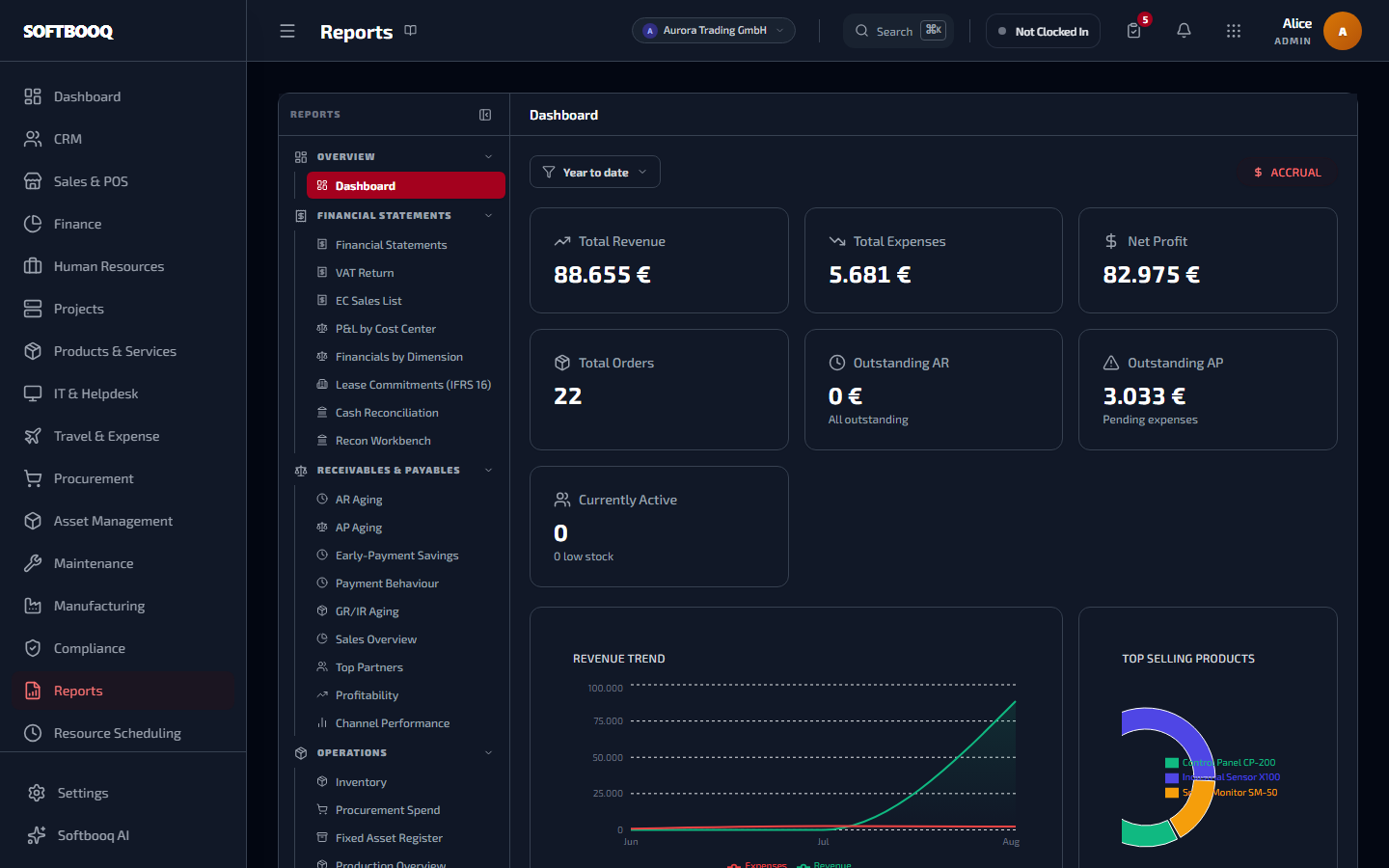
An unretouched screenshot from a live workspace.
01
The statutory set, in the shape your standard expects
A German balance sheet is not an IFRS one with different words. The structure itself is prescribed, and this produces the prescribed structure.
Five frameworks, not one with relabelled rows
IFRS, IFRS for SMEs, US GAAP, German HGB and a custom option. The profit and loss follows HGB section 275 and the balance sheet section 266 where that is your standard, rather than an international layout with local captions.
Seven statements from one ledger
Profit and loss, balance sheet, cash flow by the indirect method split into operating, investing and financing, tax summary, statement of changes in equity, notes and trial balance. All from posted journal entries, so they agree with each other by construction.
Any line opens onto its entries
Click a figure and see the journal entries that produced it for that period, with a route through to the full ledger. Reviewing accounts stops being an exercise in trusting a total.
Cash basis or accrual, as a toggle
Switch the basis and the statements recompute, so the accrual view your accountant wants and the cash view you manage on are the same data seen two ways.
Changing standard, deliberately
A guided transition between accounting standards rather than an unlogged setting change, because moving from one framework to another is an event that has to be explainable afterwards.
02
Tax and cross-border filing
The returns that carry penalties for being late or wrong, prepared from the ledger rather than assembled by hand.
VAT return, prepared and then settled
Computed from posted entries, marked filed and marked paid, so the liability clears in the books rather than lingering as a number somebody remembers owing.
EC Sales List for zero-rated EU supplies
The recapitulative statement with each customer VAT number, country and period total - the declaration the authority matches against your customer's own return.
Audit file extraction
The structured data that tax authorities operating a SAF-T regime ask for, pulled from the same ledger the statements come from rather than compiled specially.
03
Profit sliced the way your business is organised
A single company-wide result tells you that something changed, never which part of the business changed it.
Profit and loss by cost centre
The same statement per cost centre, so a result can be attributed rather than averaged across a business where one branch subsidises another.
Pivot across any dimension you defined
Project, department, store, or a dimension of your own - because the axis that matters is rarely the one the software chose in advance.
Budget against actual, with the variance and who owns it
Consumption as a percentage, the variance in money, whether it is over, and the manager responsible - so the report reaches the person who can act on it.
Revenue by channel and by source
What each sales channel produced, and where customers came from, so spend on acquisition can be judged against what it returned.
04
The operational reports that catch money
Statements tell you what happened. These tell you what to do this week.
How your customers actually pay
Payment behaviour per customer - who pays to terms, who pays late and by how much - which is the difference between a credit limit set on instinct and one set on evidence.
Discounts captured, and discounts missed
Early-payment savings you took and the ones you let expire. Terms nobody measures are terms nobody uses.
Goods received but never invoiced, aged
What you have taken delivery of and not been billed for, by age - an accrual that is invisible in most systems until a supplier invoices for something eight months old.
A reconciliation workbench
Unmatched bank lines worked through in one place rather than chased across screens, so the month-end tie-out is a session instead of a fortnight.
Fixed asset register and lease commitments
Cost, accumulated depreciation and net book value per asset, and the undiscounted maturity analysis your lease disclosure requires - both built from the postings rather than kept alongside them.
Billable hours by project and person
What was recorded, what was billable and what was actually billed, so the gap between the three is visible while it can still be closed.
The details that took the longest
Small decisions you only make after getting them wrong.
Every one of these is a specific behaviour, chosen for a specific reason. They are the difference between software that demos well and software that survives a year of month-ends.
The statements are the ledger, not a copy of it
Every figure is computed from posted journal entries at the moment you ask, which is why the balance sheet, the profit and loss and the trial balance cannot disagree. Systems that build reports from a separate reporting table can and eventually do.
HGB is a different structure, not a translation
German statutory accounts follow the layouts prescribed in sections 275 and 266. Producing an IFRS balance sheet with German labels is not an HGB balance sheet, and an accountant will say so immediately.
Budget variance names the manager
A variance row carries the cost centre owner, not just the number. A report that says spending is 18 per cent over without saying whose spending it is gets forwarded rather than acted on.
Nothing is an island
What reaches Reports without anyone typing it again.
Every one of these is a real data path, not a promise of "full integration".
Before you ask
Questions people ask about Reports.
- Which accounting standards are supported?
- IFRS, IFRS for SMEs, US GAAP, German HGB and a custom option. Where HGB applies, the profit and loss and balance sheet follow the structures prescribed in sections 275 and 266.
- Can I see what is behind a number?
- Yes. Any statement line opens the journal entries that produced it, with a route through to the full ledger.
- Can I report on a cash basis?
- Yes, as a toggle. The statements recompute on the basis you select.
- Can I analyse profit by project or branch?
- Yes, by cost centre or by any dimension you have defined, including a pivot across them.
- Can reports be emailed on a schedule?
- Not currently. Reports are produced on demand and exported as CSV or PDF; there is no subscription or scheduled delivery yet.
- Does it produce an audit file?
- Yes, the structured extract required under SAF-T regimes, taken from the same ledger as the statements.
Where to look next.
All 18 modulesSee Reports with your own numbers in it.
Start a free 30-day trial. No card required. Try every module on Softbooq Pro from day one.