 Softbooq
Customer Relationships
Softbooq PlusThe account record that already knows what they owe you.
A pipeline sitting on the same database as the invoices. What a customer bought, what they still owe, how they pay, what was promised and by whom - answerable from the account rather than by asking finance and waiting.
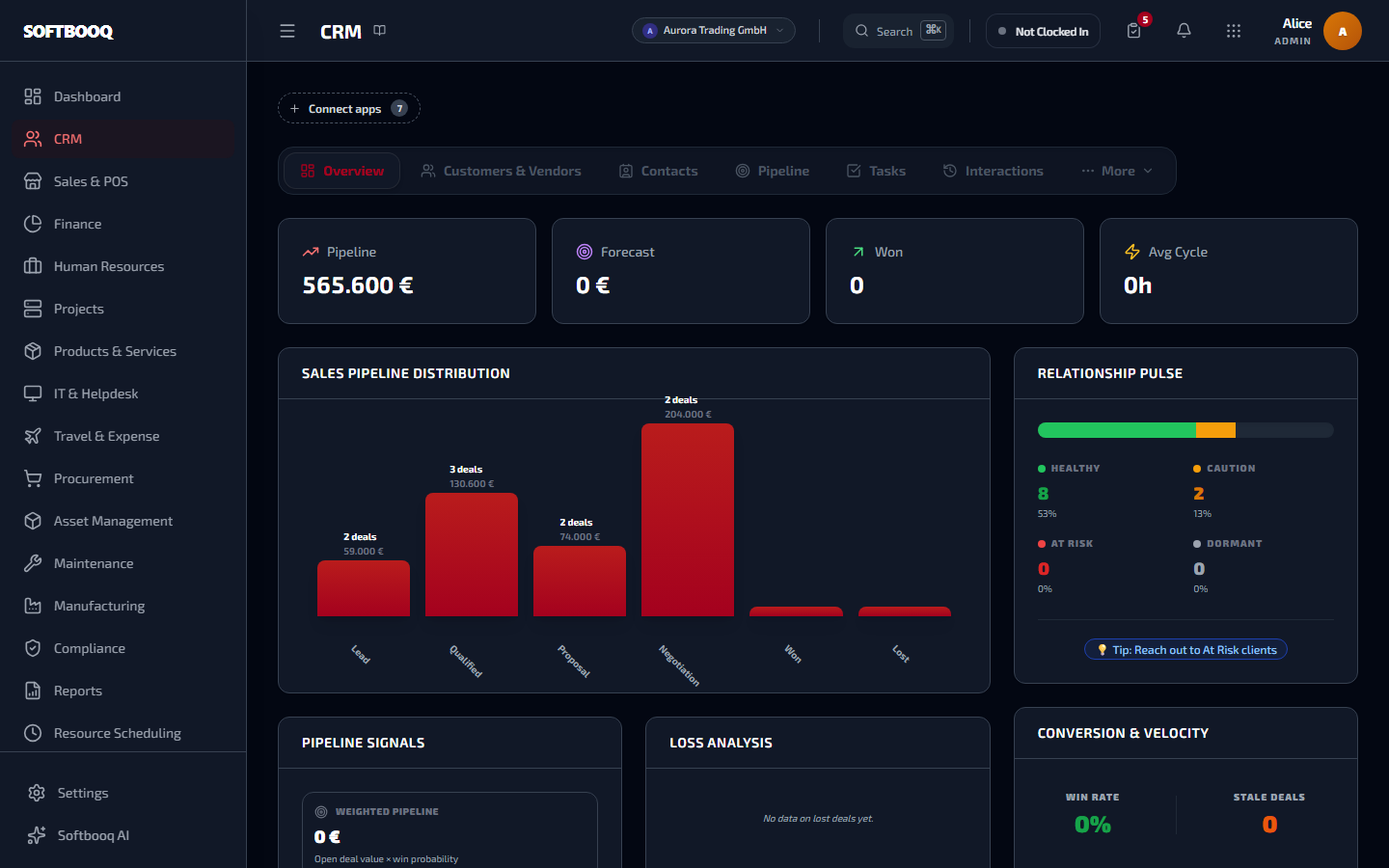
An unretouched screenshot from a live workspace.
01
Winning the work
A pipeline is only worth keeping if the reasons deals close, either way, survive the quarter.
Drag-stage pipeline with win and loss reasons
Move deals between stages and record why each closed as it did. Loss reasons captured at the moment become data; reconstructed at review time they become folklore.
Reasons you defined, not a free-text box
Structured win and loss reasons, so "price" and "too expensive" and "budget" are one category you can count rather than three you cannot.
Multi-step email sequences on a schedule
Enrol a contact or a deal and let the steps run server-side on their due dates, advancing per enrolment rather than needing anyone to remember day four.
Public forms that create real deals
A form you publish anywhere lands in the pipeline as a deal, not as an email somebody has to retype into the system before it counts.
Tasks and follow-ups against the account
What was promised, by whom, and by when - attached to the customer rather than living in one person's calendar and leaving with them.
02
One record per customer, actually
Duplicate accounts are not untidiness. They split the history that credit decisions and renewal conversations depend on.
Duplicates found server-side
Likely duplicates surfaced as a queue to review rather than discovered when two people invoice the same company differently.
Merging moves everything, then removes the loser
Invoices, deals, sales, interactions, quotes and attached files all reassign to the surviving record, platform identifiers gap-fill across, and the duplicate is deleted. A merge that leaves history behind is a merge that has to be done again.
Same-name parties resolved by identity, not by string
Matching leads with VAT number and bank identity before name, and treats an ambiguous name as a question for a person instead of taking the first hit.
Import your existing contacts
Bring a list in from a spreadsheet with the columns mapped, so moving off whatever you use now is an afternoon rather than a project.
Fields your business actually tracks
Custom fields defined per tenant and shown on the account, so the thing that matters in your trade does not live in the notes box.
03
The commercial truth on the account
This is the half a standalone CRM structurally cannot have, because it does not hold the ledger.
What they owe, on their record
Invoice history, outstanding balance and overdue aging on the customer page - so the person about to promise a discount can see the account is ninety days late without leaving the screen.
Credit limits that warn or block
Set per customer, enforced at invoicing and at the register, with an override recorded against whoever granted it rather than applied invisibly.
Payment plans visible where the relationship is
A customer paying an invoice in installments shows as exactly that on their account, so the next conversation starts from what was agreed.
Statements produced from the ledger
A full account statement built from posted invoices and payments, so what you send into a dispute agrees with your books rather than being assembled for the occasion.
One timeline for the whole relationship
Calls, emails, meetings, quotes, orders, invoices and projects in one chronology, so taking over an account does not mean interviewing the person who left.
04
Working it as a team
Ownership matters as soon as more than one person can touch an account.
Teams and account ownership
Who owns which accounts, so a pipeline can be split by team without everyone editing everything.
Every interaction logged against the account
Calls, meetings and emails recorded where the next person will look, rather than in a personal inbox that is unreachable the day it matters.
A relationship grade that shows its working
Contact recency, overdue and paid invoices, deal momentum and active projects combined into a grade that lists the factors behind it, and says "not enough data yet" instead of inventing a score.
The details that took the longest
Small decisions you only make after getting them wrong.
Every one of these is a specific behaviour, chosen for a specific reason. They are the difference between software that demos well and software that survives a year of month-ends.
The health score is a scorecard, and the product says so
Contact recency, invoice behaviour, deal momentum and active projects, combined by fixed rules. There is no model and no inference, so the interface does not imply one - it shows the grade, the factors that produced it, and a neutral state when there is nothing to grade. A confident score computed from no activity is worse than no score.
Six branches of the same chain are not one customer
Same-name parties differ in the two signals a document actually carries: the VAT identifier, which separates legal entities, and the bank account, which separates branches of one entity. Matching on name and taking the first hit is how one branch's coding, ledger account and ultimately bank details end up attached to another branch's paperwork.
A merge that leaves history behind is not a merge
Merging reassigns invoices, deals, sales, interactions, quotes and attached files to the surviving record, gap-fills platform identifiers, and then removes the duplicate. Anything less produces two half-accounts and a credit decision made on the wrong one.
Nothing is an island
What reaches CRM without anyone typing it again.
Every one of these is a real data path, not a promise of "full integration".
Before you ask
Questions people ask about CRM.
- Can I see what a customer owes from the CRM?
- Yes. Invoice history, outstanding balance and overdue aging appear on the account record without switching module.
- Can it stop a sale to a customer over their limit?
- Yes. A credit limit can warn or block, enforced at invoicing and at the register, and any override is recorded against the person who approved it.
- How does merging duplicates work?
- Invoices, deals, sales, interactions, quotes and attached files reassign to the surviving record and the duplicate is deleted, so no history is stranded.
- Is the relationship health score AI?
- No. It is a fixed scorecard over contact recency, invoice behaviour, deal momentum and active projects, and it shows the factors that produced the grade.
- Can I add fields specific to my business?
- Yes, defined per tenant and displayed on the account record.
- Can customers reach their own information?
- Yes, through an invite-only client portal showing their invoices, projects and support requests.
Where to look next.
All 18 modulesSee CRM with your own numbers in it.
Start a free 30-day trial. No card required. Try every module on Softbooq Pro from day one.